Duality
By Shalma Wegsman Gueron
Issue 002: GravityOn a clear night, you can make out the craters on a full moon with a naked eye. On a similar night, a sixteenth-century astronomer wouldn’t have seen those same craters. The moon, like all celestial objects, was then believed to be a perfectly smooth sphere. Its imperfections were imperceptible, explained away by quirks of the eye, or just ignored altogether. It wasn’t until Galileo Galilei first looked at the moon through a telescope in 1609 that the existence of the craters became undeniable.
We perceive the world through the limited lens of what we know to be possible. In 1962, the philosopher of science Thomas Kuhn introduced the idea that science is a series of progressive paradigm shifts, each getting humanity one step closer to uncovering the complete picture of reality. But modern science has come upon an impasse that challenges the idea that there is a single truth to uncover. The story of how it happened starts with a young man who went off-script and created a new way to interpret his world.
At the turn of the twentieth century, Albert Einstein was an unemployed college graduate. Deemed unfit to teach physics, the subject of his degree, he spent two years without work before his friend’s father stepped in and secured him a job as a patent clerk. Each day at the job, Einstein would finish his tasks as early as possible, clearing up the afternoons to let his mind wander. In these boundless daydreams, he began pulling on loose strings of reality, starting with the speed of light.
By this time, physicists knew that light travels at the same speed—the fastest speed allowed in the universe—no matter how fast you are moving when you measure it. Einstein realized that this implies something strange about our world: In order for the speed of light to stay the same, time and space must warp. He imagined two people, one on a fast-moving train, and the other on a platform watching it go by. A beam of light bounces up and down within the train car. To the person on the platform, this light is traversing both the height of the train, and the distance forward the train has moved. Speed is the distance traveled in a certain amount of time. If the two observers measure the same speed, but different distances, then time must have passed by for them differently.
And so Einstein realized that as you approach the speed of light, your clock ticks more slowly. Space and time aren’t the same to everyone, they are relative to the motion of whoever is observing them. The insight led Einstein to his theory of special relativity, which he published in 1905.
He then followed another clue: Heavier objects don’t fall any faster than lighter objects. Isaac Newton was aware of this two centuries earlier, but Einstein saw the insight hiding in this fact. A situation where objects fall to the floor is identical to one where the floor rises to meet the objects. Gravity was thought to be a force of attraction between massive objects, but this observation hinted that a perspective shift could make gravity look very different. Einstein pursued it to build a new theory of gravity.
Einstein published the theory, called general relativity, in 1915. According to this theory, space and time are part of the same fabric, which Einstein called space-time. This fabric curves, expands and contracts depending on what’s inside of it. The force of gravity is explained by a curving of space-time: When you travel near a heavy object, space curves, bending your path towards it. Time curves too, slowing your clock down the closer you get.
General relativity is captured by a set of equations, called the field equations, which can be expressed in a single line of dense mathematics. These equations tell you exactly how space-time is reshaped by the matter and energy contained inside of it. They can describe any universe, not just ours. The field of dreams was expanded.
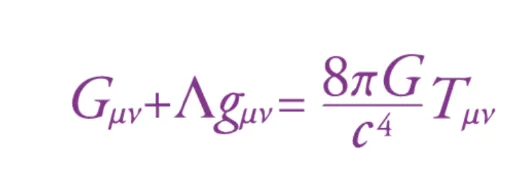
Einstein’s equations say that if you squeeze matter into a small enough space, the space-time around that matter will reach infinite curvature. The result would be an object so gravitationally intense that nothing can escape it, what we now call a black hole. Even light, which has no mass and was previously believed to be impervious to gravity, would follow the curves of space-time into a black hole, never to be seen again.
Once imagined, black holes remained science fiction for decades. Most people believed that they were a physical impossibility. This changed in 1965, when the physicist Roger Penrose proved that a black hole must form after the death of a large enough star. The proof, which won a Nobel Prize, dragged black holes out of fiction and into reality. They have since settled comfortably into the cultural consciousness. We now know that our own galaxy would not exist without the giant black hole in its center, and in 2022 we took its photograph. An object that’s been in our cosmic backyard all along has only just come into view.
But there’s a problem. Einstein’s theory sits like an island, disconnected from the rest of fundamental physics.
The rest of physics speaks the language of quantum mechanics, which can be thought of as the physics of the very small. Quantum mechanics explains all the forces besides gravity, as well as the fundamental particles and their interactions. It does this all with remarkable precision. And yet, there is no way to reconcile it with the language of Einstein’s gravity.
Most physicists find discomfort in the large gap between these two theories, and they hope for them to one day be united. But attempts to consolidate them have so far required expanding our universe into multiple unseen extra dimensions—at least six or seven—that exist without us noticing them. To explain this, these theories suppose that the extra dimensions are rolled up too small for us to enter: We are like monsters, too large to realize that a straw is not a line but rather a small, rolled-up cylinder. These theories of quantum gravity are usually deemed untestable; they venture farther into the unknowable than our headlights permit us to see.
While searching for a single theory of quantum gravity, researchers stumbled upon a strange discovery. Wandering in a world unlike ours, they found a translation between Einstein’s theory and the quantum one. This translation is called a duality.
In a duality, two entirely distinct mathematical descriptions describe identical worlds. Some dualities are uninteresting. For instance, you could rewrite all of physics with an electron’s charge being positive instead of negative. This would give you two alternate descriptions of the same laws of electricity, but your understanding of the nature of electrons wouldn’t change.
This duality is much more enthralling. It’s called the Ads-CFT correspondence, and the paper detailing its discovery has been cited far more than even that of Einstein’s theory*.
On one side of the duality is Ads, which stands for anti-deSitter space. This is a universe with a space-time described by Einstein’s equations, but which contains no matter or energy. It’s a world where parallel lines diverge as they travel, and where it takes four lefts to make a right.
On the other side of the duality is CFT, or conformal field theory. This is a quantum theory, which describes the same world as a set of quantum fields and particles. It does so without the need for gravity, or Einstein’s concept of space-time, at all.
These two descriptions don’t just look different, they disagree on foundational truths. They disagree on the number of dimensions of space for instance; a three-dimensional anti-deSitter space is equivalent to a flat, two-dimensional CFT world. (For this reason, it’s called a holographic duality, since a three-dimensional world can be seen as emerging from a flat one.) The laws of physics in these two worlds also differ: A single particle in Einstein’s description may map onto multiple particles in the quantum one. And yet, ask both theories any practical question—for instance, to predict the chance of two particles colliding—and they return the same answer. They describe the same exact reality.
Since we do not live in the universe described by this duality, it’s possible to write it off as a strange mathematical quirk. On the other hand, pay attention to it, and you’ll find a challenge to the nature of truth. Duality suggests there isn’t only one truth, or one theory of everything. What’s true depends on the language it’s spoken in.
Even in human languages, translation is rarely one-to-one. A single word in one language can take a sentence to be described in another. Where one language may distinguish many kinds of sea, snow, or love, another may blend and blur them all together. Without the words with which to see the differences, we don’t. This is why Kuhn says that when we speak different languages, we experience different worlds. Language and world are learned together.
What we express in any language can only approximate the wealth of our inner experiences. Within each of us is a world of distinct meanings. As we learn the nuances of each other’s languages, we start to feel the presence of what’s left unsaid. In this gap you’ll find everyday dualities—simultaneous truths, mixed emotions, difficult translations. It’s in these dualities that the immensity within each of us peeks through.
What’s left unsaid in the gaps between our theories? Duality lets us portal back and forth between different scientific realities; from one where the universe is made up of space and time, to another where space and time are illusions, like holograms, emerging from a deeper quantum reality. Whether our world has a preference is yet to be known, or perhaps never will be.
*At the time of writing, the Ads-CFT paper has 25,435 citations. Einstein’s general relativity paper has 2,210, though for fairness the original paper is in German.
Shalma Wegsman Gueron is currently a science writing fellow at Quanta Magazine, and co-host of the podcast Why This Universe. She holds a Master’s in Physics from NYU.
 NOTCH IS NOW ON SUBSTACK