Secrets of the Puckered Jug: Velázquez and Teaching
By Alexander Nemerov
Issue 002: Gravity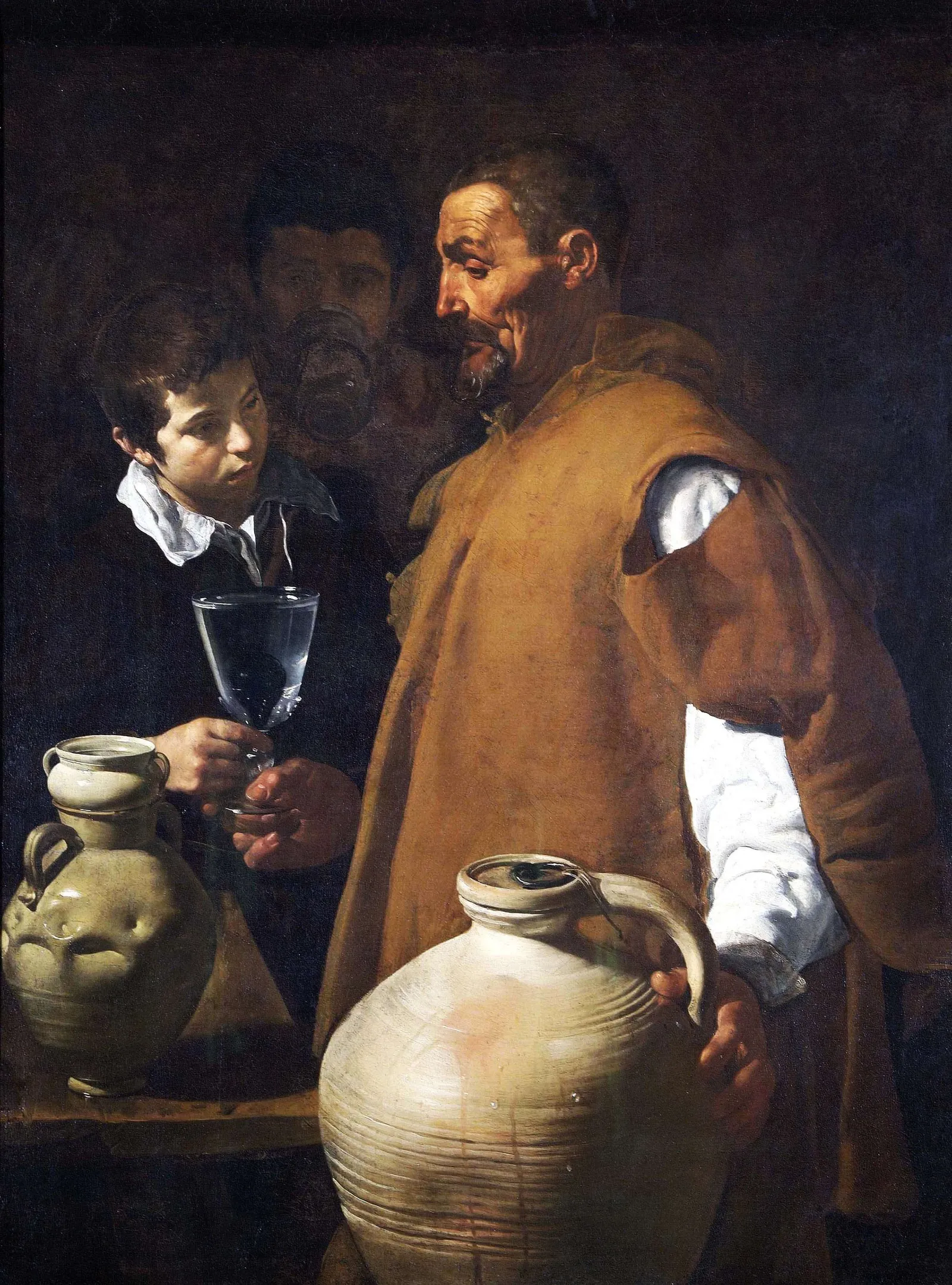
Water Carrier of Seville
c. 1618–1622
oil on canvas
105 × 80 cm
Courtesy: Apsley House, London
Descending into the Hyde Park Corner tube station in London, I passed a shaggy busker who blurted out, “There’s a lot of low-I.Q. people round here these days.” I turned to commiserate, then realized he meant me. He had a point. Who teaches and who learns and why does anyone do either?
I had taught this question in a lecture at Stanford—taught it in front of a big slide of the painting I had come to London to see, Diego Velázquez’s Water Carrier of Seville, installed at Apsley House, a few steps from where the busker stood.
The painting had clicked for me a few years ago. It seemed to tell all there is to know about the gravity of my chosen profession as a teacher. A gray-haired man in a dun-colored smock stands before a large earthen jug. Burnt by the sun, wearied at his task, the man looks down at the glass of pure water he has filled to the brim for a young boy who accepts the glass from his hand. A third figure, a young man possibly faded over time and more obscure than the boy and water carrier, quaffs a drink in the background between them. The water carrier is the teacher; the boy is the student; the mysterious drinker between them is some mix—who knows—of both.
The old man as the teacher struck me most. The drops of water flowing down the jug’s earthen side might be his own sweat and tears. The swollen rounded form of the jug is one with his stout chest, his strength and his burden the same. The jug’s handle makes a match for his ear; the roundness of his head is sculpted of earth. Bearing his precious burden, he has carried the water from a source high in the mountains or low in the ground. Whether from a secluded stream or hidden aquifer, he brings life to those on the level plain.
The boy, a model student, receives the gift with courtesy. The transaction seems hardly a transaction at all but some solemn rite. (I prefer to call the painting the Water Carrier and not the Water Seller, its alternate title.) No money passes between the two; only the glass. Velázquez, only about twenty years old when he painted it, and newly married to the daughter of his art teacher Francisco Pacheco, evokes the sacred bond between pupil and instructor. What passes between them is a font of the clearest water, a sightless substance, a transparency manifest in the clouded glass and (because everything must have the taste of some tarnish) a fig or deformity in the blown glass that grows like a bulb at the bottom.
It is all a mystery. How the water got into the glass is not shown. The jug is massive, a grave thing indeed. The water carrier’s smock is made for him to lift it: open at the shoulder, the sleeve allows him to raise the vessel without ripping his clothing—but the lifting and pouring are as if they never were. Only the few drops dribbling down the side suggest how the glass got filled. The effort of teaching, the weeping of teaching, itself a gravity of descending tears and sweat, happens front and center (the cascading water is nearer to us than the figures themselves), but all behind the scenes. There is only the communion between the young and the old.
The bond is a heartwarming fantasy—except the water carrier and boy do not look at each other. Lost in thought, the old man stares at the glass. The boy steals a furtive glance at the water carrier, but he too seems in his own world. Velázquez probably posed them separately, combining separate models and modeling sessions into the completed picture. Perhaps each model did not even grip a glass but rather a rope suspended from the studio ceiling (a common practice designed to lessen the fatigue of holding a difficult pose). However it was, they dream their separate dreams. The boy’s is that of the puckered jug on the staggered table, a cup in its mouth. The old man’s is like the concentric circles of clay rounding his great pot: circulating with his own energies, he is an interior, self-enclosed, a wellspring.
It does not look good if this is what teaching is. The classroom is a place where two isolations confront one another, lost to one another. Yet as I have come to see it, this is the hope of what happens there. The teacher portrays his own inwardness. He cannot help but do it if he is to bear his gift. He extends that inwardness outward, in the form of a gift, a gift that is sold, strictly speaking, but more truly given, volunteered, in an act of service to another person. That person may receive the gift without grasping it; he may hold it in trust. He may even hold it not for himself but for a person more powerful than him—for his employer, say. The boy with his dignified but tatty collar could be the house-servant for someone we do not see, a person too superior to descend to the street to pay for the drink—someone, in other words, who will drink the water instead of the boy. Yet it is all the same in the end. The exchange between the teacher and student is gracious beyond the uses to which unseen others might put it.
And the drink-quaffer in the background? Perhaps he shows the quick-and-easy consumption of what is so precious it must be more delicately taken in hand. His very fading might stem from his vulgar thirst, as if whatever he drinks, water or otherwise, were a potion causing him to fade. Or perhaps he too was once avid, as up front and rounded as the boy and the old man, the old man who is the centrifuge of himself, throwing the energy of his inwardness outward. But over time the background drinker and the potion that once gave him life have faded. The elixir of learning has become only a quick drink. The potency of this fading lurks between the man and the boy.
There is something else. Are the man and the boy in the foreground the same person? Is teaching—the gravity of it—really a matter of teaching who one oneself has been? If so, the water carrier bestows a gift upon his former self, blessing and forgiving whoever he was when he was young and did not know better. The boy, for his part, might be returning the favor to his older self. The glass is so measured halfway between them that it might be the boy who bestows it on the man, even though we know otherwise. The boy gives to the person whom he will be, acknowledging that this person, sunburnt and ragged, is still as pure as when he was young.
In the classroom, everyone—aged teacher and young students—is the same age. It is an age of all times, one in which each person is the sum of all the times they have ever lived and will live. The child is father to the man, as Wordsworth says, and the father generates the child whom he was. It is a gentle awareness. We are always who we have been and always who we will be. The lessons learned and the lessons forgotten are like the memory of a weight held in the hands. There is sorrow but redemption in the sadness, which takes the crystal-clear form of a realization, possibly a last thing (if one believes that Velázquez painted the glass last). It is that there is no such thing as a lecture that is not also a “last lecture,” that the meaningfulness of any day’s topic is the loss that it betokens, the fullness that it bestows, that of the generations shaped from the same clay, the world of disgust and violence redeemed in a moment of peace. The glass is heavy but so light.
I come back, last, to the busker in the tube station. With his gray hair, he might almost have been the water carrier, transported from the painting to the tunnel beneath the street outside the museum. If so, he was wise to teach me my lesson, to remind me that mine are but words, fantasies of what I do and why. But this is my song, and I am the busker too.
Alexander Nemerov is the author most recently The Forest: A Fable of America in the 1830s, praised by the novelist Annie Proulx as “one of the richest books ever to come my way—deeply beautiful, achingly painful and astonishingly tender.".
Carlos Valladares is a writer, critic, and curator. He writes for many magazines, including Gagosian Quarterly, Art in America, and n+1. He is currently devising his first feature film. He lives in New York, grew up in Los Angeles, and misses Paris.
 NOTCH IS NOW ON SUBSTACK